
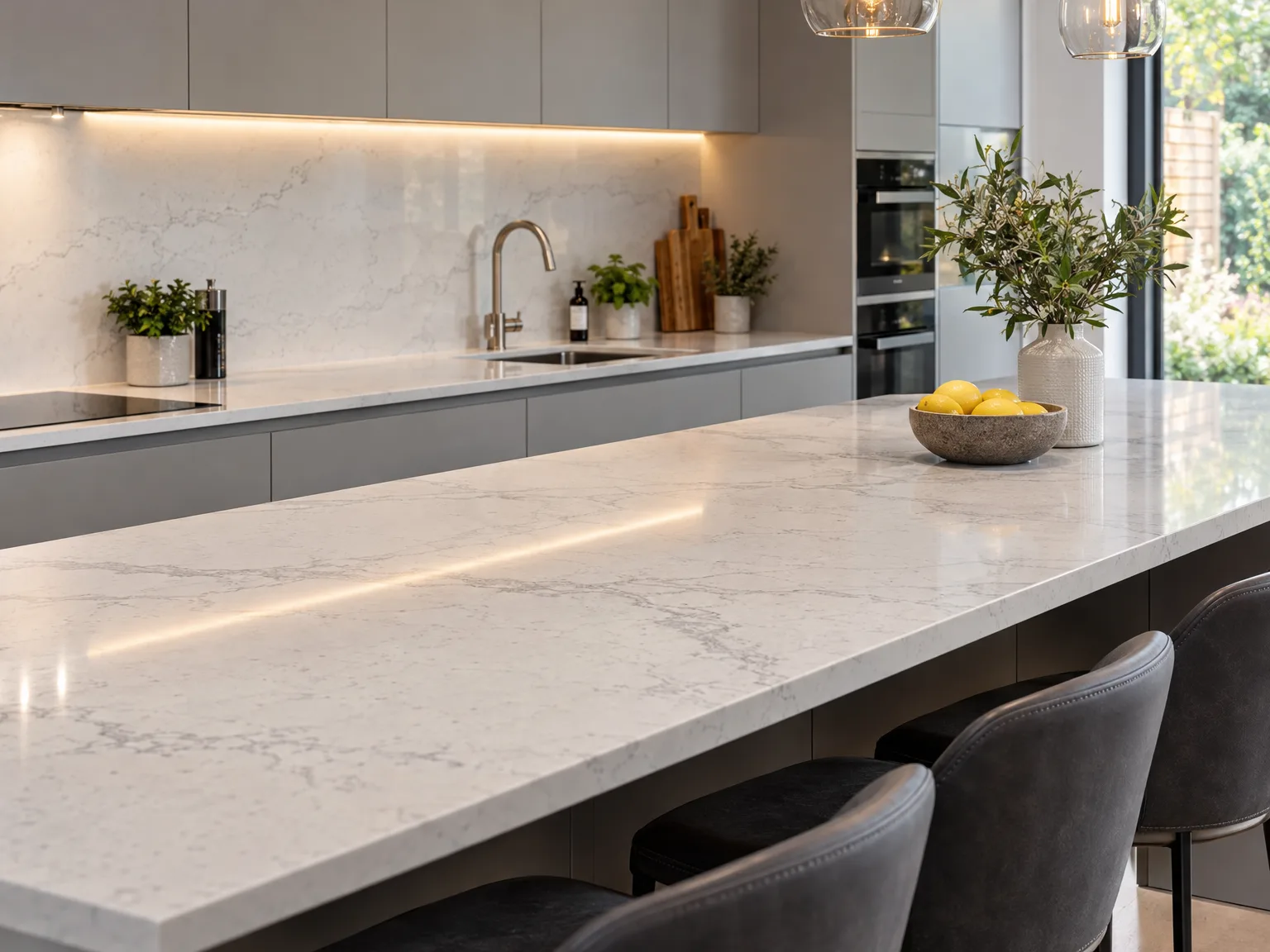
Why a quartz stone worktop is ideal for busy kitchens
The kitchen demands materials that can withstand constant use without sacrificing appearance, and a quartz stone worktop delivers exactly that - combining lasting durability with effortless, hygienic maintenance.
Table of contents
- Why a quartz stone worktop is ideal for busy kitchens
- What sets a quartz stone worktop apart from natural stone
- The non-porous nature of a quartz stone worktop and why it matters
- How a quartz stone worktop resists staining, scratching and bacteria
- The minimal maintenance reality of living with a quartz stone worktop
- Choosing the right quartz stone worktop for your kitchen style
- Why accurate templating is critical to a successful quartz stone worktop installation
- The role of professional fitting in the final quality of your quartz stone worktop
- Coordinating plumbing and electrics around your quartz stone worktop
- Edge finishing options that complete the look of a quartz stone worktop
- Planning your renovation schedule around quartz stone worktop fitting timescales
- What to expect from a transparent quote for a quartz stone worktop
- Is a quartz stone worktop the right long-term choice for your home?
- FAQ - Frequently asked questions
Why a quartz stone worktop is ideal for busy kitchens
The kitchen is the most demanding room in any home. Spills, heat, chopping, scrubbing - surfaces take constant punishment throughout the day. For households that need both performance and good looks, the choice of worktop material matters enormously.
Built to handle daily demands
A quartz stone worktop is engineered precisely for this environment. Its surface resists scratching and staining without ever needing sealing, so it stays presentable under relentless use. The non-porous structure also inhibits bacterial growth - a genuine advantage for families where hygiene is a daily priority.
Consistent looks, minimal upkeep
Beyond durability, quartz offers something natural stone simply cannot guarantee: visual consistency. As an engineered material, the colour and pattern remain uniform across the entire surface, with no unpredictable tonal shifts to manage. The result is a worktop that is as reliable to live with as it is satisfying to look at.
What sets a quartz stone worktop apart from natural stone
Natural stone is beautiful, but it comes with caveats. Marble, granite and slate each form under unique geological conditions, meaning every slab carries its own inconsistencies - veining that shifts unexpectedly, porous patches that absorb stains, and surfaces that require periodic sealing to stay protected.
Engineered for consistency
A quartz stone worktop is made differently. Manufacturers bind natural quartz crystals with resins and pigments under tightly controlled conditions, producing a material whose colour, pattern and density remain predictable across every metre. What you see in the showroom is precisely what arrives in your kitchen - no surprises, no compromises.
Performance without the upkeep
That engineered composition also makes quartz non-porous by nature. Where granite demands regular sealing and marble stains at the first splash of red wine, quartz resists both without any intervention. For a busy kitchen, that kind of built-in reliability is not a luxury - it is the whole point.
The non-porous nature of a quartz stone worktop and why it matters
The non-porous surface is what truly separates quartz from natural stone options like granite or marble. Because the material contains no open pores, liquids, oils and food residues cannot penetrate beneath the surface - they sit on top until wiped away.
What non-porous means in practice
A quartz stone worktop offers a genuinely sealed surface straight from the factory, with no periodic resealing required. This matters most in a busy kitchen, where spillages are frequent and time for maintenance is limited.
- Coffee, wine and cooking oils stay on the surface rather than soaking in
- Bacteria cannot colonise hidden micro-cavities within the material
- Cleaning requires nothing more than a damp cloth and mild detergent
Why traditional materials fall short
Granite and marble need regular resealing to close their natural pores. Without that upkeep, staining and bacterial growth become genuine concerns - drawbacks that the non-porous nature of quartz entirely avoids from day one.
How a quartz stone worktop resists staining, scratching and bacteria
Quartz is an inherently hard mineral, and when engineered into a worktop surface, that hardness translates directly into everyday resilience. The manufacturing process binds crushed quartz crystals with resins and pigments under intense pressure, producing a dense, non-porous slab with virtually no surface gaps for liquids to penetrate. A red wine spill, a smear of raw meat juice, or a splash of cooking oil sits on the surface rather than seeping into it - wipe it away and nothing remains.
H3: Why bacteria cannot take hold
That same non-porous structure denies bacteria the microscopic crevices they need to colonise. Unlike wood or unsealed stone, there are no fissures where moisture and organic matter accumulate overnight. For families preparing meals daily, this makes hygiene straightforward rather than effortful.
H3: Hardness that handles daily impact
The hardness of a quartz stone worktop also protects against scratches from knives, utensils and abrasive cleaning products. Surface marks that would dull or pit softer materials leave little impression here, keeping the finish looking consistent long after installation.

The minimal maintenance reality of living with a quartz stone worktop
One of the most liberating aspects of choosing a quartz stone worktop is what you no longer have to do. Natural stone surfaces-marble, granite, limestone-demand periodic resealing to prevent liquids from penetrating and staining the material. Skip a treatment, and the surface becomes vulnerable. With quartz, that cycle simply does not exist.
No sealing, ever again
Because quartz is non-porous by nature, it repels liquids without any specialist treatment. Spills sit on the surface rather than soaking in, and a quick wipe is genuinely all most messes require. Busy households with young children or frequent cooking can rely on that predictability every single day.
Upkeep that fits real life
Freeing yourself from sealing schedules means one less specialist product to buy and one less task to remember. Routine care stays straightforward: mild detergent, a cloth, done. For families who want a beautiful kitchen without the maintenance burden of traditional materials, that simplicity is a genuine daily benefit.
Choosing the right quartz stone worktop for your kitchen style
Your kitchen's character lives in its surfaces, and few decisions shape it more than your worktop. Quartz arrives in an extensive palette of pigments, finishes and veining patterns - from cool whites and deep charcoals to warm stone-effect hues - so the right match always exists, whatever your starting point.
Reading your cabinetry and flooring
Begin by identifying the dominant tones in your existing cabinetry and flooring. Cool-toned units call for grey or white quartz with subtle veining, whilst warm timber shades pair naturally with cream or earthy finishes. Contrasting rather than matching can work brilliantly too - a dark worktop against pale cabinetry creates bold definition.
Contemporary versus traditional interiors
A polished, minimalist quartz stone worktop suits sleek handleless kitchens, whilst a honed or textured finish softens country and Shaker-style spaces. The engineered nature of quartz means it adapts visually to both aesthetics without compromise.
Why accurate templating is critical to a successful quartz stone worktop installation
Precision at the templating stage is not a formality - it is the single step that determines whether your finished installation sits flush, functions correctly, and looks exactly as intended. Errors made here cannot be quietly corrected later; quartz is cut to template, and a flawed template produces a flawed result.
What templating must capture
A thorough template accounts for every variable in your kitchen:
- Exact perimeter measurements, including any irregularities in walls or cabinetry
- Precise sink positions and cut-out dimensions
- Locations for hobs, tap holes, and any other penetrations
The cost of getting it wrong
Remedial work on an installed quartz stone worktop is expensive and disruptive. Re-cutting, re-fitting, or re-ordering slabs adds considerable time and cost to a project that should otherwise run smoothly. Investing in careful, professional templating from the outset is simply the most reliable way to protect that investment.

The role of professional fitting in the final quality of your quartz stone worktop
Quartz is an engineered material that leaves little margin for error. The slab arrives precisely cut, and from that point every decision a fitter makes-how securely the worktop is seated, how cleanly the edges are dressed-determines whether the finished kitchen looks genuinely considered or merely adequate.
Secure positioning changes everything
An uneven base, however slight, creates stress points that compromise both the structure and the appearance of the surface. Professional fitters identify and correct substrate irregularities before placement, ensuring the worktop sits flush without flex or movement under daily use.
Edge finishing as the real test
Raw or poorly dressed edges reveal the quality of an installation immediately. Expert edge finishing transforms a quartz stone worktop from a functional slab into a defining visual element-one that reads as intentional rather than incidental. This is not an optional refinement; it is precisely what separates professional fitting from a job that simply gets done.
Coordinating plumbing and electrics around your quartz stone worktop
Fitting a kitchen involves more moving parts than many homeowners anticipate. The sink needs plumbing connections, appliances require electrical work, and your quartz stone worktop must be cut, positioned and finished around both - all in the right sequence.
The Cost of Separate Trades
When different contractors handle each discipline, timing conflicts and communication gaps are almost inevitable. One trade overruns, another can't start, and the entire installation gets pushed back - sometimes with costly rework as a consequence.
One Team, Total Integration
Choosing a single team to coordinate the fitting alongside plumbing and electrics eliminates those gaps entirely. Every component is planned as part of one joined-up process:
- Sink cut-outs are templated precisely before plumbing connections are confirmed
- Appliance positions are agreed before any electrical routing begins
- Final finishing happens once all trades are complete, not piecemeal
The result is a kitchen that comes together cleanly, on schedule and without unwelcome surprises.
Edge finishing options that complete the look of a quartz stone worktop
The edge profile is often the last detail chosen and the first thing guests notice. Far from a cosmetic afterthought, the finishing along each exposed side gives the entire surface its visual signature-whether that reads as sharp and architectural or soft and tactile.
From straight lines to ogee curves
A straight or pencil edge suits contemporary, handle-free kitchens where clean geometry is everything. A bevelled profile catches light and adds subtle dimension without competing with other design elements. At the other end of the spectrum, an ogee profile-with its flowing S-shaped curve-lends a more classical, furniture-like character that complements traditional or Shaker-style interiors beautifully.
Matching the detail to your design
When specifying a quartz stone worktop, the chosen profile should work in harmony with cabinetry lines, tap styles and splashback materials rather than stand in isolation. Professional edge finishing, executed with precision, ensures every transition between stone and surrounding surfaces looks thoroughly considered rather than simply functional.

Planning your renovation schedule around quartz stone worktop fitting timescales
Knowing what to expect from your renovation timeline removes a great deal of stress. Fitting a quartz stone worktop is not a same-day process - accurate templating must come first, capturing precise measurements of your kitchen layout, sink positions, and any specialist cut-outs. Only once those measurements are confirmed can fabrication and installation be scheduled.
Allow time for templating
The gap between templating and fitting means your kitchen will be out of action for a period. Discuss timescales with your installer from the outset so you can plan meals, arrange temporary cooking facilities, and prepare the household accordingly. Clear communication at this stage helps you avoid unnecessary stress mid-renovation.
Coordinate tradespeople in advance
Where plumbing, electrics, and worktop fitting all need to align, early coordination prevents costly delays. A single team managing all elements keeps the schedule tight and reduces the risk of one trade holding up another.
What to expect from a transparent quote for a quartz stone worktop
A quotation is more than a figure on a page-it is the foundation of trust between client and tradesperson. Before committing to this prominent centrepiece of a kitchen renovation, understanding exactly what the investment covers helps homeowners avoid unexpected costs and misunderstandings.
What a fair quote covers
A transparent quote should itemise every stage: templating, fabrication, fitting, sink cut-outs and edge finishing. When a single team handles plumbing, electrics and worktop installation together, the quote becomes a coherent picture rather than a patchwork of separate invoices. Confirm whether removal of an existing worktop is included and that lead times are clearly stated.
Terms that protect both parties
Clear terms around payment schedules, changes to site conditions and cancellation policies ensure no surprises mid-project. For any quartz stone worktop installation, written confirmation of templating and fitting dates also allows you to plan disruption realistically and proceed with full confidence.
Is a quartz stone worktop the right long-term choice for your home?
For families weighing a significant kitchen upgrade, the decision comes down to reliability. A quartz stone worktop delivers consistently - resisting staining, scratching and bacterial growth without demanding the ongoing maintenance traditional materials require. That combination of resilience and low effort makes it a genuinely practical choice for years ahead.
Built for everyday family life
The material's non-porous surface means heavy use and spills leave no lasting mark. Its appearance remains consistent over time, looking just as appealing years later as it did on the day of installation.
Long-term value, simply achieved
- Minimal upkeep reduces effort across the lifetime of the kitchen
- Consistent appearance preserves visual appeal without refinishing or sealing
- Reliability suits families who want performance without compromise
Choosing quartz means investing in a surface that works as hard as the household does - and continues to look the part throughout.

FAQ - Frequently asked questions
What are the main advantages of quartz stone worktops compared to natural stone materials?
Quartz stone worktops offer superior durability and consistency. Unlike granite, marble or slate, quartz is engineered to resist scratching and staining without requiring sealing. The colour and pattern remain uniform across the entire surface, whereas natural stone carries unpredictable variations in veining and tone. Additionally, the non-porous structure inhibits bacterial growth, making quartz a more hygienic choice for family kitchens.
Why does quartz stone not require sealing like natural stone does?
Quartz is non-porous by nature due to its engineered composition. Manufacturers bind natural quartz crystals with resins and pigments under tightly controlled conditions, creating a sealed surface from the factory. Natural stone like granite and marble, by contrast, contain open pores that demand periodic resealing to prevent staining and bacterial growth. Quartz eliminates this maintenance entirely.
How does the non-porous surface of quartz benefit everyday kitchen use?
The non-porous surface means liquids, oils and food residues cannot penetrate the material - they remain on the surface until wiped away. This prevents coffee, wine and cooking oils from soaking in, stops bacteria from colonising hidden cavities within the material, and makes cleaning straightforward with just a damp cloth and mild detergent. For a busy kitchen where spillages are frequent and maintenance time is limited, this built-in reliability is invaluable.