
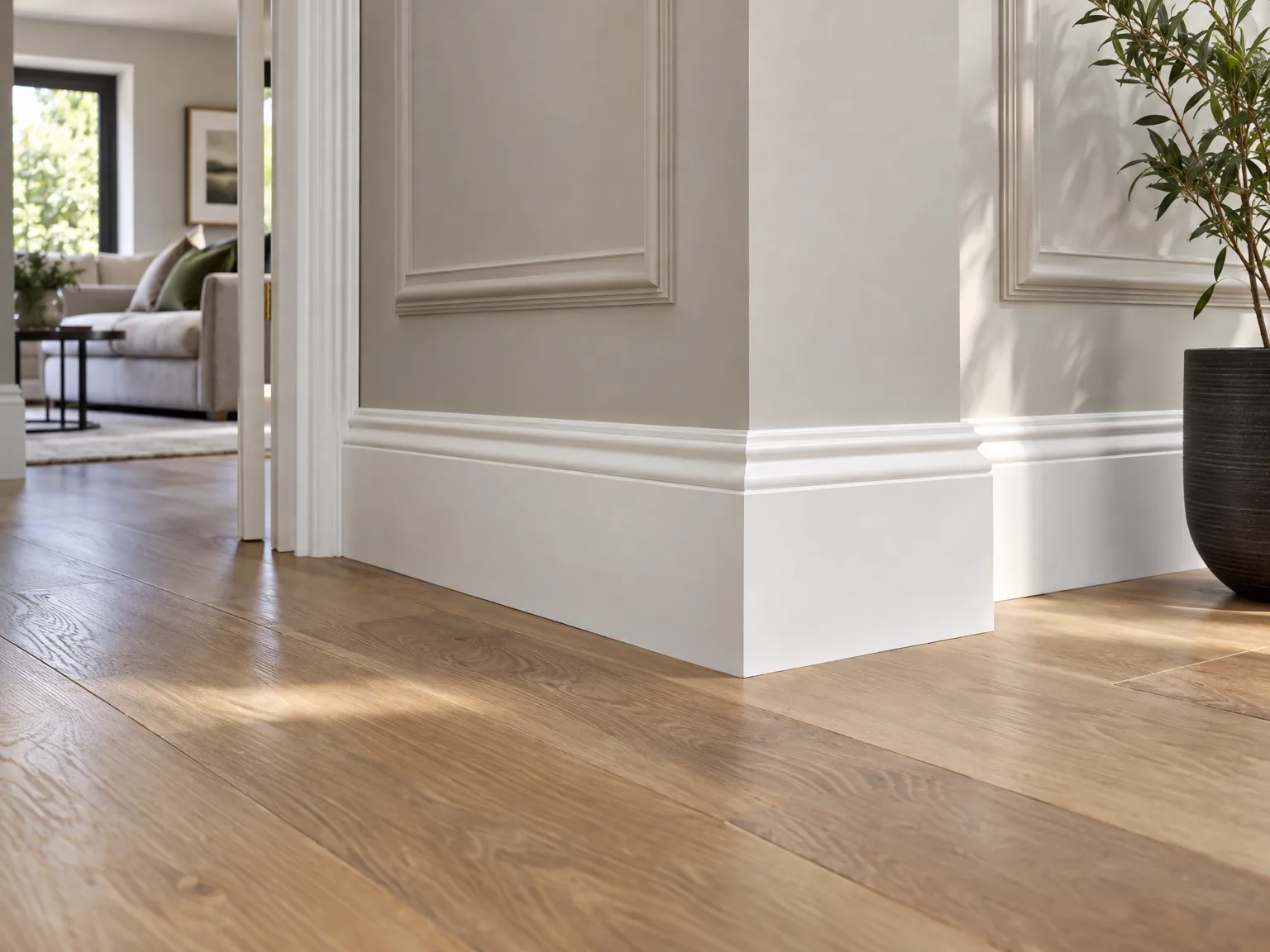
Why Deep Skirting Boards Transform Your Home
A deep skirting board transforms a room's character, lending architectural solidity and an unmistakable sense of refined craftsmanship. The impact is immediate and enduring, elevating every element of the space.
Table of contents
- Why Deep Skirting Boards Transform Your Home
- What Makes a Deep Skirting Board Different From Traditional Trim
- The Visual Impact of Deep Skirting Boards in Contemporary Interiors
- How Deep Skirting Boards Enhance Proportion in High-Ceilinged Rooms
- Concealing Cables Behind a Deep Skirting Board
- Protecting Your Walls With a Deep Skirting Board in High-Traffic Areas
- Choosing the Right Material for Your Deep Skirting Board
- Precision and Preparation: The Key to Fitting Deep Skirting Boards
- Why Deep Skirting Boards Suit Kitchen and Bathroom Renovations
- Coordinating Trades When Installing Deep Skirting Boards
- Achieving a Seamless Finish With Professionally Installed Deep Skirting Boards
- How Deep Skirting Boards Bring Visual Coherence to a Complete Renovation
Why Deep Skirting Boards Transform Your Home
Few interior details carry as much visual weight as the transition between wall and floor. Traditional skirting boards do a quietly functional job - but raising that profile changes everything. A well-fitted deep skirting board installation shifts rooms from ordinary to architecturally considered, adding a sense of solidity and intention that immediately reads as high-end craftsmanship.
Proportion, Presence, and Purpose
The difference is especially clear in rooms with higher ceilings, where increased height restores visual proportion and genuinely grounds the space. The impact is both immediate and lasting - a detail that elevates every element surrounding it.
Practical Benefits, Elegant Delivery
Beyond aesthetics, deep skirting boards deliver real everyday value:
- They conceal cable routes cleanly, removing the need for exposed surface trunking.
- They protect walls in high-traffic areas from scuffs and everyday wear.
- They bring visual coherence to kitchen and bathroom renovations where clean lines define the entire scheme.
What Makes a Deep Skirting Board Different From Traditional Trim
Standard skirting boards do a quiet job. They sit at floor level, protect the base of a wall, and mostly go unnoticed. That is precisely what makes the difference so striking - a deep skirting board commands the room through height alone, shifting from background detail to deliberate architectural feature.
Height Changes Everything
Where conventional trim hugs the floor almost apologetically, deeper profiles make a confident design statement. They draw the eye upward, emphasise ceiling height, and lend rooms the considered proportions associated with high-end refurbishments.
More Than a Visual Upgrade
The practical advantages compound the aesthetic ones:
- Greater wall coverage offers meaningful protection in high-traffic areas.
- The added depth conceals cable routes, keeping interiors clean and uncluttered.
- The more substantial profile integrates seamlessly with modern flooring and wall treatments.
Together, these qualities elevate what might seem like a minor trim decision into one of the most impactful choices in an interior renovation.
The Visual Impact of Deep Skirting Boards in Contemporary Interiors
In contemporary high-end renovations, proportion is everything. Where standard trim recedes into the background, the deep skirting board commands attention - anchoring the room visually and drawing the eye downward to reinforce architectural solidity.
Grounding Rooms with Confidence
The increased height creates a visual weight at floor level that balances taller ceilings and open-plan layouts. This grounding effect works particularly well alongside:
- Neutral wall palettes, where the trim defines the boundary between surfaces with quiet authority
- Smooth, large-format flooring, where the board's height echoes the material's expansiveness
- Minimal cabinetry and built-in furniture, reinforcing clean horizontal lines throughout the space
Coherence Across the Interior
Rather than functioning as an afterthought, deep skirting boards integrate into the overall design language - lending each room a sense of considered refinement that distinguishes a truly polished interior from a merely functional one.
How Deep Skirting Boards Enhance Proportion in High-Ceilinged Rooms
Tall walls are impressive, but without the right visual anchoring they can feel cold and disconnected from the living space beneath. When a room rises generously overhead, the eye craves a counterbalance - something to establish scale at ground level and tie the vertical planes together.
Grounding the room visually
A deep skirting board accomplishes precisely this. By increasing the transition height between floor and wall, it creates a substantial base that feels proportionate to the full height of the room. The result is a space that reads as considered and complete, rather than simply large.
Balancing floor, wall, and ceiling
This proportional relationship - heavy base, open middle, defined ceiling - mirrors the classical logic of architectural columns and cornices. In contemporary interiors, the same principle applies: a taller board at the base adds visual weight where it matters most, making height feel deliberate rather than accidental.

Concealing Cables Behind a Deep Skirting Board
The additional depth behind a deep skirting board creates a natural, hidden channel along the base of your walls - the ideal route for power cables, data leads, and home automation wiring. Rather than chasing cables into plaster or leaving unsightly surface trunking on display, the void behind the board keeps everything contained and completely out of sight.
H3: A Cleaner Wall, Effortlessly
The result is a wall surface free from clips, conduits, and trailing wires. Rooms feel calmer and more considered, with nothing to interrupt the clean lines of the skirting itself. It is a practical benefit that works silently in the background, yet makes a visible difference the moment you walk into the space.
H3: Plan Before You Fix
Routing cables at this stage requires coordination across trades. Electricians, carpenters, and decorators need to agree on cable positions before the boards go up permanently, ensuring every wire reaches its destination without compromising the finished result.
Protecting Your Walls With a Deep Skirting Board in High-Traffic Areas
In hallways, kitchens, and busy living spaces, walls take a constant beating - from furniture edges, vacuum cleaners, bags, and passing foot traffic. Standard skirting offers limited coverage, leaving a significant stretch of plaster exposed to daily knocks and scuffs.
A Wider Shield for Busy Spaces
The greater height of a deep skirting board means it intercepts impacts across a far larger area of the lower wall, stopping damage before it ever reaches the plaster. This matters most in narrow corridors and kitchen zones, where movement is constant and furniture sits close to the walls.
Less Maintenance, Longer-Lasting Finish
Because the board absorbs the wear instead of the wall surface beneath, the need for patching, filling, and repainting is noticeably reduced. The result is an interior that stays looking crisp and well-kept for considerably longer, even in the most heavily used rooms.
Choosing the Right Material for Your Deep Skirting Board
The choice of material shapes every stage of the project - from the first cut to the final coat of paint. Timber remains a popular choice for its workability and timeless finish, whilst modern alternatives offer advantages in terms of stability or moisture resistance. Each option demands a specific approach to cutting, fixing, and finishing, and selecting the wrong material for a given environment can compromise the result from the outset.
Timber vs. Modern Alternatives
- Painted timber suits both traditional and contemporary settings but requires thorough preparation and priming before finishing.
- Modern alternatives can offer greater dimensional stability, particularly useful in kitchens or bathrooms where humidity fluctuates.
- Each material behaves differently at joints and mitres, so the technique must adapt accordingly.
Matching Material to Setting
Selecting the right material for your deep skirting board is ultimately about matching performance to environment. A bathroom demands different properties than a hallway, and the finish must be fully compatible with the base material from the outset.

Precision and Preparation: The Key to Fitting Deep Skirting Boards
The difference between a deep skirting board installation that looks effortless and one that falls short at the joints often comes down to what happens before a single piece is fixed. Walls are rarely perfectly flat - without thorough preparation, even quality timber reveals every imperfection beneath it.
Templating and Wall Preparation
Accurate templating is the foundation of a clean result. Each length must be measured and profiled against the actual wall surface, accounting for any irregularities. Walls need checking for levelness, loose plaster addressed, and surfaces properly primed before fixing begins. Skipping these steps creates problems that no amount of finishing can fully conceal.
Fixing, Caulking, and Finishing
Secure fixing prevents movement and keeps joints tight over time. Once boards are in place, meticulous caulking at the top edge and at every internal and external corner closes gaps that would otherwise catch the eye immediately. The final paint finish unifies the whole, delivering the seamless, polished outcome that marks genuinely professional carpentry.
Why Deep Skirting Boards Suit Kitchen and Bathroom Renovations
Kitchens and bathrooms demand a level of visual precision that other rooms rarely require. Every surface - tiled splashbacks, lacquered cabinetry, polished worktops - competes for attention, and the transition between wall and floor is exactly where cohesion can break down. Getting that junction right transforms the finished result from merely functional to genuinely considered.
Tying Together Competing Surfaces
A deep skirting board brings calm to that visual complexity. Its substantial profile bridges cabinetry bases, floor tiles, and painted walls into a single composed line - rather than leaving each element to terminate abruptly at the floor with no sense of resolution.
Practical Benefits Beyond Aesthetics
These rooms also demand durability. The same feature that elevates the visual result:
- protects walls from mops, buckets, and cleaning equipment
- conceals pipework or cables behind a clean, finished face
- provides a crisp visual base that holds its own in moisture-rich environments
Coordinating Trades When Installing Deep Skirting Boards
Fitting deep skirting boards is rarely a solo carpentry task. Because the boards run behind radiator pipes, beneath socket positions, and alongside freshly painted walls, the sequence in which trades operate matters as much as their individual workmanship. Get that sequence wrong and rework follows - and rework is costly.
Sequence Determines Everything
Plan electrical first, carpentry second, decorating last. Chasing out cable runs before boards are fixed prevents the nightmare of opening up fresh paintwork to route a hidden cable. Agree on trunking and socket positions with the electrician before any cutting begins.
Keep All Trades in the Loop
- Carpenters need to confirm final flooring height before templating begins.
- Electricians must agree socket positions before boards are scribed and fixed to walls.
- Decorators require fully secured and caulked boards to achieve clean, professional paint lines.
Integrated planning from the outset keeps every trade informed, every phase properly sequenced, and the finished result cohesive.

Achieving a Seamless Finish With Professionally Installed Deep Skirting Boards
The difference between a good result and a truly outstanding one comes down to craft. Even the finest materials will look ordinary if joints are poorly mitred, caulk is applied unevenly, or the painted finish is rushed. Precision at every stage - from templating to final coat - is what transforms timber into a genuinely refined architectural detail.
Where Workmanship Makes the Difference
A deep skirting board installation involves several finishing steps that each demand patience and skill:
- Joints must be cut and fitted with accuracy to avoid visible gaps at corners and junctions.
- Caulking should be applied neatly to seal the board against the wall without smearing onto the paintwork.
- Paint coats require proper preparation and sanding between layers to achieve a smooth, lasting surface.
The Result Worth Getting Right
When these elements come together correctly, the outcome is immediately apparent - clean lines, a crisp silhouette, and surfaces that look entirely at home within the wider interior.
How Deep Skirting Boards Bring Visual Coherence to a Complete Renovation
A complete renovation is only as strong as its least considered detail. When every room shares consistent proportions, finishes, and trim, the result feels intentional rather than assembled - and that sense of wholeness is precisely what a well-specified deep skirting board delivers across an entire project.
Unifying Proportions Across Every Room
Deep skirting boards bring visual coherence when specified consistently throughout a home. They anchor each space to the same design logic, ensuring that transitions between rooms feel deliberate rather than disjointed. The repeated horizontal line they create at floor level ties together varying wall colours, floor materials, and architectural features.
A Detail That Defines the Whole
Coordinating skirting with carpentry, electrical works, and painting trades during a renovation ensures that the finished result reads as a single, considered scheme. What might appear a minor trim choice becomes the thread that connects every element - making spaces feel complete rather than simply finished.